Tuesday, 30 April 2013

Bungonia.


For my second freelance article with the magazine Go Camping Australia, I covered the volunteer campground host program in national parks.  I traveled to a couple of parks to interview the hosts.  Bungonia State Conservation Area is about a 2-hour drive southwest of Sydney.  I camped there overnight to have more time to check out the area.

Bungonia is known for its limestone caves, among the deepest on mainland Australia.  Bordering the park is a limestone mine, which provides more than half of the raw materials for cement in NSW.  It is used to produce iconic buildings such as the Sydney Opera House.  The mine can be spotted from many lookout points.  Because it’s a bit of an eyesore, I decided not to include it in my vista photo below.


As I mentioned, Bungonia has caves.  Adventure-seekers come for caving, abseiling, rock climbing, canyoning, and canoeing.  The caves are also occupied by large bent-wing bats.  The bats use different caves for different purposes (breeding, hibernating, etc.), so depending on the time of year certain caves might be closed to the human public.  Below is the entrance to the Grill cave.


Because I was there to conduct an interview, I didn't have time (nor proper equipment) to explore the caves.  However, it is definitely something to try if I make another trip out there.  I did have some time to do some bushwalking.  The morning before I left, I happened up some kangaroos.  I was very excited to finally be close enough to see (and photograph) a joey poking out of the pouch.


I also found this spider – a golden orb weaving spider.  The female spiders are quite large; this one was maybe 3 inches in length with the legs bent.  The small red spider above is the male, waiting for an opportunity to mate.  The webs are quite strong as well; they are known to catch birds and bats, which the spider will wrap up and eat.  Fortunately, they are a low risk to humans.


Wednesday, 17 April 2013

Capital City.


Another ultimate tournament brought me to a new place.  Canberra, located in the Australian Capital Territory (ACT), is the capital of Australia.  The ACT is surrounded by New South Wales, between Sydney and Melbourne.  Those two cities had (and still have) a fierce rivalry, so the purpose-built capital city was created.  Partially following the designs for Washington D.C., Canberra has many geometric features with roads in a wheel and spokes pattern rather than the easy to navigate grid system.  One of the prominent features is the artificial lake named Lake Burley Griffin.  The lake is in the photo below, as is the National Carillon on Aspen Island.  This tower is one of the world’s largest musical instruments with 55 bronze bells, weighing up to 6 tonnes each.  It was a gift from Britain on Canberra’s 50th anniversary.  My tournament was only a few weeks after Canberra’s centennial anniversary.


So that I would see a bit more of Canberra than just its ultimate fields/ovals, I drove down to the city a bit early.  I had an afternoon to grab a delicious lunch at a vegan cafĂ© and check out some of the sights.  As Canberra is largely known for its museums and politics, we did a self-guided walking tour in the Parliament Triangle to check out the architecture and pop inside a couple of the major institutions.  I probably should have included some of the embassies on my mini tour, as many are custom-built with interesting architecture.  I did, however, see the Aboriginal Tent Embassy on the lawn in front of Old Parliament House.  It was originally established back in the 1970’s.  In general, I was surprised by how quiet the area was; I expected to see more visitors walking around and inside the museums.


Canberra is Australia’s largest inland city, and being further inland it showed more signs of autumn than coastal Sydney.  The nights were cooler, and the leaves on the trees are starting to turn color.  That weekend was also the end of Daylight Savings.  Lately, I have been experiencing my biggest struggle with the seasonal differences.  To me, this time of year marks the period when days are growing warmer and longer.  That’s the direction I prefer, so it’s hard adjusting when things are going the opposite way here.


With this visit to the ACT, I have passed the halfway point.  I have now visited both territories (ACT and NT) and 3 states (QLD, NSW, and VIC).  Now only 3 states remain: Tasmania, South Australia, and Western Australia.  Which one should I visit next?

Sunday, 31 March 2013

Lamington, take 2.

Brief follow-up to a previous post:  A few weeks ago, I came across a vegan lamington (the dessert this time, not the National Park)!  Of course, I had to give it a go. 


As I previously described, it is a sponge cake, coated with chocolate and then sprinkled with coconut flakes.  The photo shows how thin the coating of chocolate is.  Overall, the cake was a bit denser than I expected.  For some reason, I also thought it would be dry, so I was pleasantly surprised by how moist it was.  I would definitely eat it again… perhaps served with jam next time?  Or better yet, I should try out some recipes to make my own.

Monday, 18 March 2013

Croajingolong.


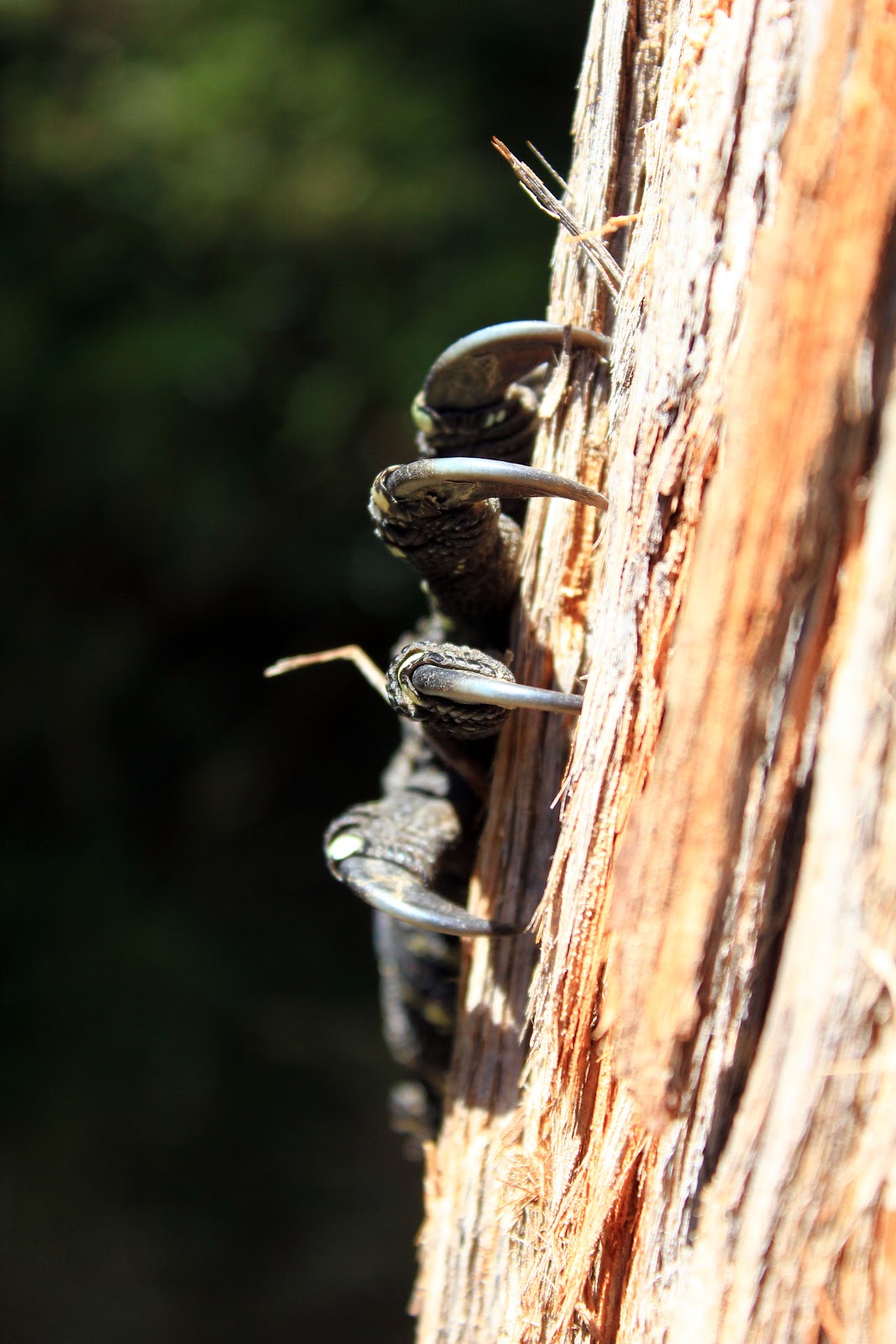
My, what sharp claws you have.  Any guesses on the owner?
My touring week was quickly ending, and I had not progressed more than a few hours outside of Melbourne on my coastal drive back to Sydney.  I figured I could spend another half day checking out an area somewhere along the way.  It was difficult to choose one spot among all the many excellent places to explore.  Driving past some places, I could not help but feel some regret that I did not have more time.  So many sights and experiences to witness… it is easy to understand why people will take it slow in this area.  I also realized why people might take it slow in any area.  There can be so much to explore locally.  I cannot say that I have fully explored any area where I have lived; there was always more to discover.  You can always be exploring…
This time, I decided to spend a few hours hiking in Croajingolong National Park, which is located in the southeast corner of Victoria.  Croajingolong NP is one of 12 World Biosphere areas in Australia.  Such protected areas are internationally designated for promoting and demonstrating sustainable development. 

 
While hiking, I had moments when my surroundings felt familiar, as though I was back hiking on the other side of the world.  They would not last long though… something like the laughing call of a kookaburra or the thumps of a wallaby in the bush would bring me back to reality and Australia.  Or perhaps the snake hanging out in the one flooded section of the trail.  I still have not identified this species, but I am comfortable with assuming all snakes I encounter in Australia are venomous and giving them plenty of space.
 
Did you guess a lace monitor as the owner of the claws?  S/he is as long as I am tall, even longer with that forked tongue extended (monitors are the only lizard with forked tongues).  Those sharp claws are for climbing trees, where lace monitors spend much of their time.
After leaving Croajingolong, I came across another Aussie animal next to the road.  I stopped to make sure this echidna was okay (and to snap a couple of photos).  Cute and cuddly, eh?

Saturday, 9 March 2013

The Prom.

Wilsons Promontory National Park.  Located in Victoria, the Prom contains the southernmost tip of mainland Australia.  Surrounded by water on three sides, it is a bit isolated, but its isolation helps make it an iconic wilderness.  Hit the numerous hiking trails to catch the spectacular natural scenery and spot some of the abundant wildlife.


Head up high to view gorgeous angles of the coastline.  One of the beaches is named Squeaky Beach, because the rounded grains of sand ‘squeak’ when you walk/slide your feet on it.  I had first noticed this phenomenon on some beaches in southern Queensland, but no one else there seem surprised by it.  I am glad it was finally acknowledged here. 

 
I was ‘mobbed’ by eastern kangaroos while on the short wilderness walk.  It was awesome.  I actually went back another day to repeat that walk.  Ever feel like you are being watched?
 
 
Even though there are heaps of folks staying at the campgrounds in Tidal River, including school groups, it was easy to feel quite secluded out on hikes.  How about having a bay, complete with orange lichen covered rocks, all to yourself?  On my way there, I came across this swamp wallaby.  I am pretty sure I interrupted him/her from enjoying the beautiful views during his/her dinner.  Hopefully, s/he still caught that night’s sunset.
 
 
Since arriving in the southeastern part of Australia a few months ago, I have had a new Aussie animal on my mission list – the wombat.  Wombats dig burrow systems with easy to spot entrances given their size.  When threatened (by dingoes or Tasmanian devils), they duck into burrows; any predators who follow have a hard time getting a grip on their tough rear ends.  The Prom is well-known for its wombats, so surely this was place I would see one.  When checking in at the ranger station, the ranger told me not to keep food in my tent, as wombats have been known to chew holes through tents to get to food.  Instead, food would be safe in my car… no need for bear lockers here.  The ranger also suggested that I just walk around the campground at night to spot one.  No luck my first night.  It was quite dark when I returned to my campsite the second night and guess what was waiting for me.  A wombat, of course!  Super cute and munching on the grass.  S/he waddled toward me at one point, perhaps seeking a handout or a pet (it was hard to resist).  I tried to take a photo, but I didn’t want to use a flash, so it didn’t come out.  Fortunately, I spotted another one along the road the next day after leaving the Prom.  Sadly, this wombat is suffering from mange with its missing fur and irritated skin.  Still cute to me!
 

Tuesday, 5 March 2013

Mornington, Nighttime.

Another ultimate frisbee tournament returned me to the state of Victoria.  This tournament was in Geelong, which is southwest of Melbourne.  After the tournament, I used the week to explore some more as I slowly headed back toward Sydney.  First off, I drove all the way around Port Phillip [Bay] to reach the Mornington Peninsula on the other side.  This area is a favorite destination for Melburnians over holidays and long weekends.    

The Peninsula has several seaside villages with sandy beaches on Port Phillip.  These beaches have been popular for well over a century.  Some of them still have the iconic colorful bathing boxes, which were first built in the 1880’s.
The calm and protected waters in the bay are inviting to families, whereas the risky and exposed waters on the other side of the peninsula appeal to surfers.  In 1967, the Prime Minister disappeared while swimming on this side.  The walks in the Mornington Peninsula National Park provide beautiful viewpoints of the shoreline.
I decided to take advantage of my recent open water diving certification, so I went diving around the Portsea Pier (Port Phillip side) with the hopes of spotting weedy sea dragons.  This creature was voted as the marine emblem of Victoria in 2002.  It is endemic to the coastal waters in the southern half of Australia with a strong concentration in Victoria.  It has leaf-shaped appendages to camouflage itself among the seaweed and kelp.  (The leafy sea dragon has even more of these appendages.)  The weedy sea dragon is related to sea horses and pipefish, but it doesn’t have the ability to anchor itself with its tail.  Instead, it tends to drift with the current.  It was easy to check them out closely when I drifted alongside with the surge.  I rented an underwater camera for this dive, but frustratingly the battery ran out during the trip.  (I’m disappointed the dive shop did not offer a partial refund.)   While no shots of the puffer fish also spotted, I did get a couple of decent shots of some weedy sea dragons.
 

Monday, 28 January 2013

Takin' on the jellies.


On my 6th month anniversary of arriving in Australia, I completed my PADI (Professional Association of Diving Instructors) open water diving certification.  Because I completed the theory portion via eLearning beforehand, the practical portion was into two packed days.  We spent most of the first day in a pool, practicing our skills, before our first ocean dive (at Oak Park in Cronulla, south of Sydney) that afternoon.  All of our dives were shore dives, which meant we had to practice lugging around the heavy equipment.  On the second day, we completed three ocean dives around Bare Island in Botany Bay.  Here’s a photo of an alien me giving the okay signal.


It’s quite amazing to be able to breathe underwater, but I did find the two days to be exhausting.  As it was all new to me, it was both physically and mentally challenging.  However, I think that with more dives, it should become easier.  As I become more comfortable, I will be able to explore the underwater world more.  It certainly opens up plenty of adventures.  Based on my first dives, I know I want to learn how to better identify some of the species I see.  Our instructor did coax out three octopuses, which was very neat to see.  She also pointed out a stonefish and warned us not to step on it (see the post titled Things that could kill me…).

This past Saturday was Australia Day.  Plenty of events going on, but I decided to advantage of the free concerts.  I saw Ash Grunwald play in the park directly below the Harbour Bridge within view of the Sydney Opera House.  Excellent music in a beautiful location on a summer day – what more do you need?